
Entities operating in the European Union will most likely be given an additional year to prepare for the EUDR. Most likely, because the postponement procedure is still ongoing. EU institutions are agreeing on the final text of the regulation, and whether the requirements will actually come into force with a delay depends on when they finish. However, the deadline will most likely be postponed, so we decided to take a look at the planned changes.
The EUDR is an EU regulation establishing obligations for entities trading in goods whose production involves a risk of deforestation or forest degradation. EUDR goods cover seven categories of goods. The European Commission has determined that these goods pose the greatest risk of deforestation during production. cocoa, coffee, soybeans, oil palm, cattle, rubber, wood.
The regulation requires entities that trade in these goods and products made from these goods to meet a number of requirements. Let's say a company sells rubber products, such as tires. Such a company will have to check and report on the following:
Failure to meet any of the above or many other EUDR requirements will result in a ban on the sale of products on the EU market and their export from the EU. Financial penalties of up to 4% of the company's total annual turnover are also envisaged. The regulations aim to reduce the scale of deforestation and forest degradation worldwide.
You can read more about EUDR requirements in our tab dedicated to the regulation – https://echoeg.com/eudr-okresl-i-zrealizuj-z-nami-swoje-obowiazki/
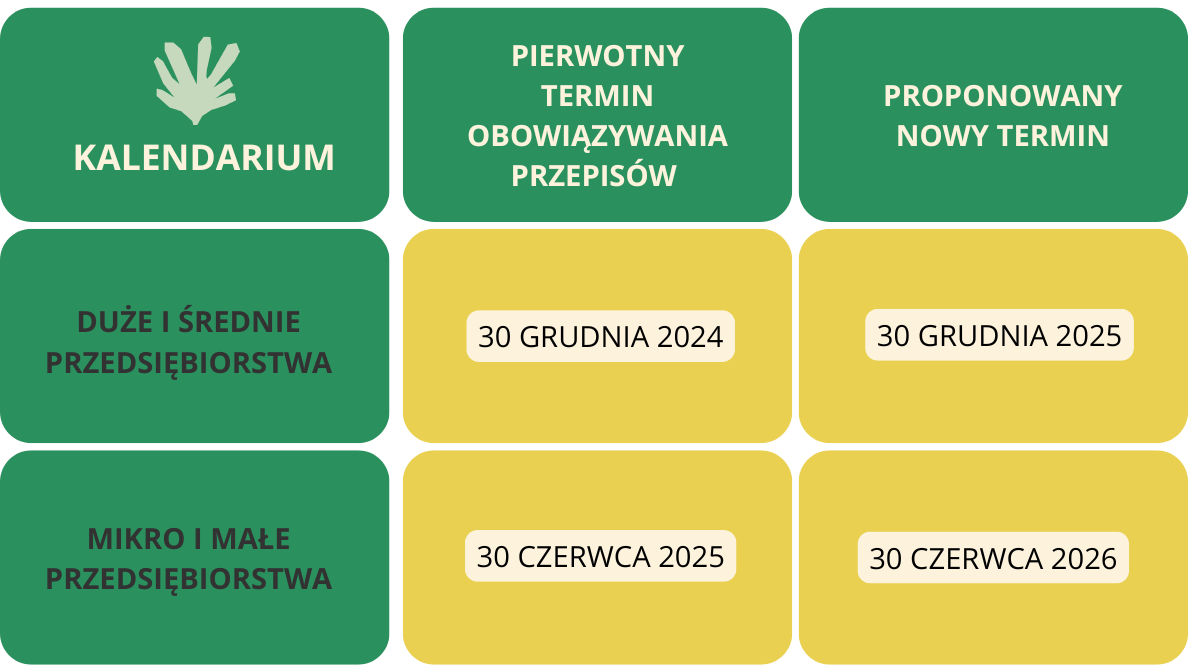
The regulation in question has not yet been fully implemented, and changes to its content have already been proposed. Originally, the provisions were to come into force on December 30, 2024, for large and medium-sized enterprises, and on June 30, 2025, for small and micro-enterprises. In October, the European Commission requested that the date of application of the regulation be postponed by one year.
On November 14, 2024, the European Parliament approved the Commission's proposal, but this does not mean that the postponement of the regulations by one year is certain. The new wording of the regulation is to be submitted to a parliamentary committee, where an interinstitutional discussion will take place. The text will have to be approved by both the Council and the Parliament. Only then will it be published in the Official Journal of the EU. It is uncertain whether the European Union will manage to postpone the regulations in time, although everyone expects this solution. The changes to the EUDR calendar are illustrated in the graphic below:
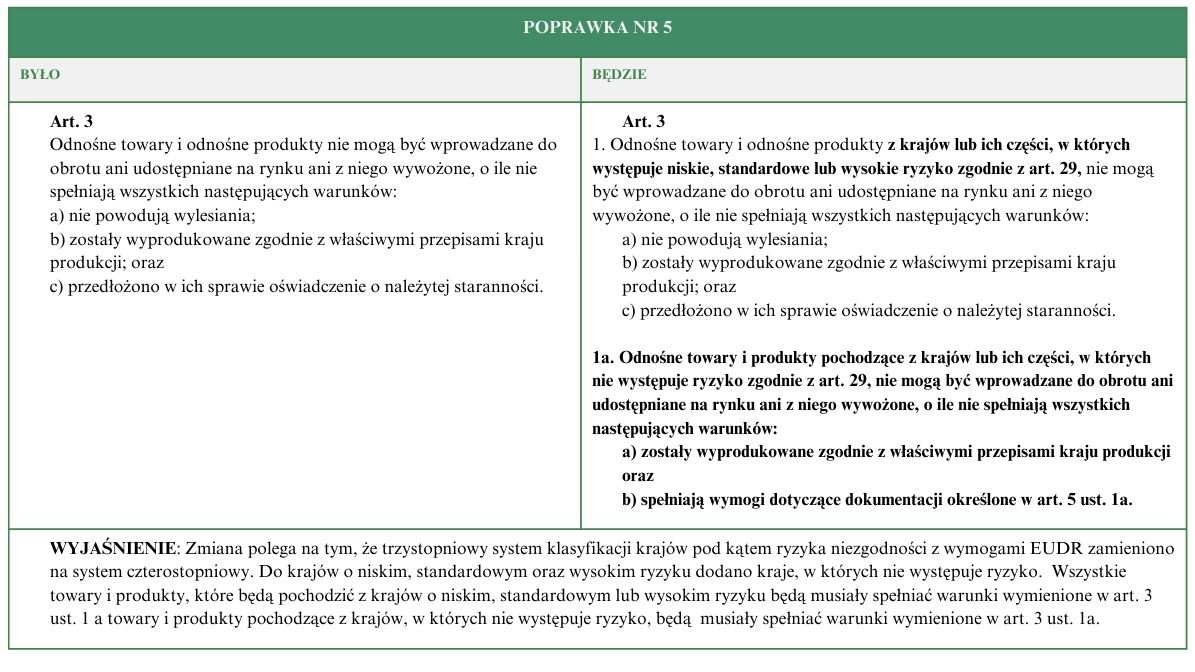
Most stakeholders are aware that work is underway to officially postpone the effective date of the EUDR. However, the European Parliament has also accepted several other amendments proposed by the Commission. These changes will have an equally significant impact on the final wording of the regulations. The most significant change is the introduction of a four-tier system for classifying countries or parts of countries in terms of their risk of non-compliance with EUDR requirements, instead of the three-tier system. The existing categories are:
added
All amendments adopted by the European Parliament on November 14, 2024, are described in an accessible table with explanations of the changes introduced (an excerpt from the content we have prepared is shown in the graphic below).
If you would like to learn about the other changes, please write or call us, and we will provide you with this information free of charge. We encourage you to contact us!