EUROPEAN UNION DEFORESTATION REGULATION – DEFINE AND FULFILL YOUR RESPONSIBILITIES WITH US
xxx
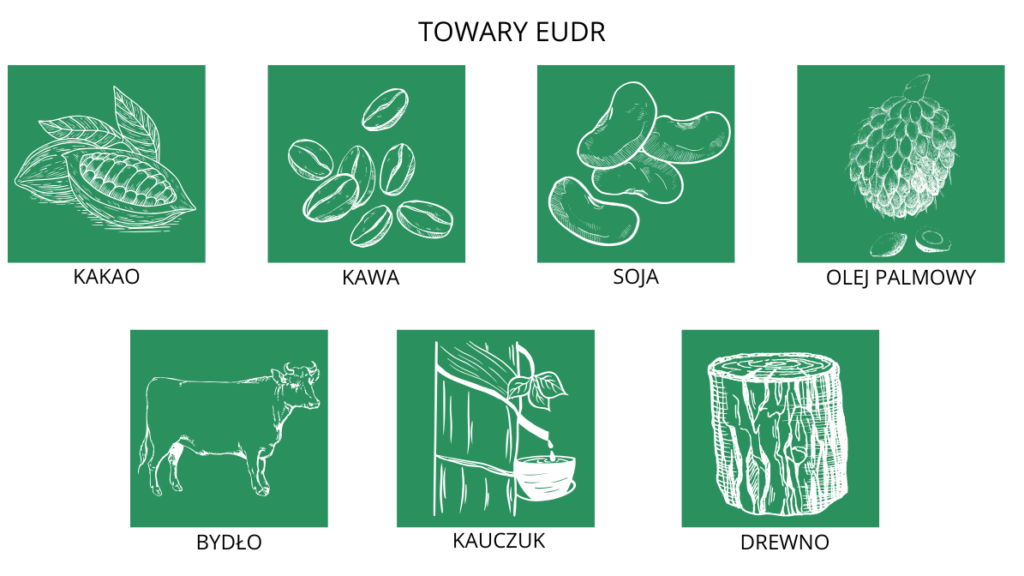
The EUDR is an EU regulation establishing obligations for entities trading in goods whose production involves a risk of deforestation or forest degradation. EUDR goods cover seven categories of goods. The European Commission has determined that these goods pose the greatest risk of deforestation during production.
xx
The regulation obliges entities that trade in these goods and products manufactured from these goods to take measures that include, among others:
supply chain monitoring
collection of geolocation data for production plots
verifying that products have been manufactured in accordance with the laws of the country of manufacture (including human rights and environmental protection laws)
xx
I. WHO IS AFFECTED BY EUDR?
The regulation applies to all entities that
place on the EU market
make available on the EU market
export from the EU market
products that contain, have been fed with, or have been produced using EUDR commodities (note: cocoa, coffee, soy, palm oil, cattle, rubber, wood).
If you are unsure about your role in the market and your responsibilities, we invite you to take advantage of our services.
xx
II. OUR SERVICES
xx
What will you gain by working with ECHO?
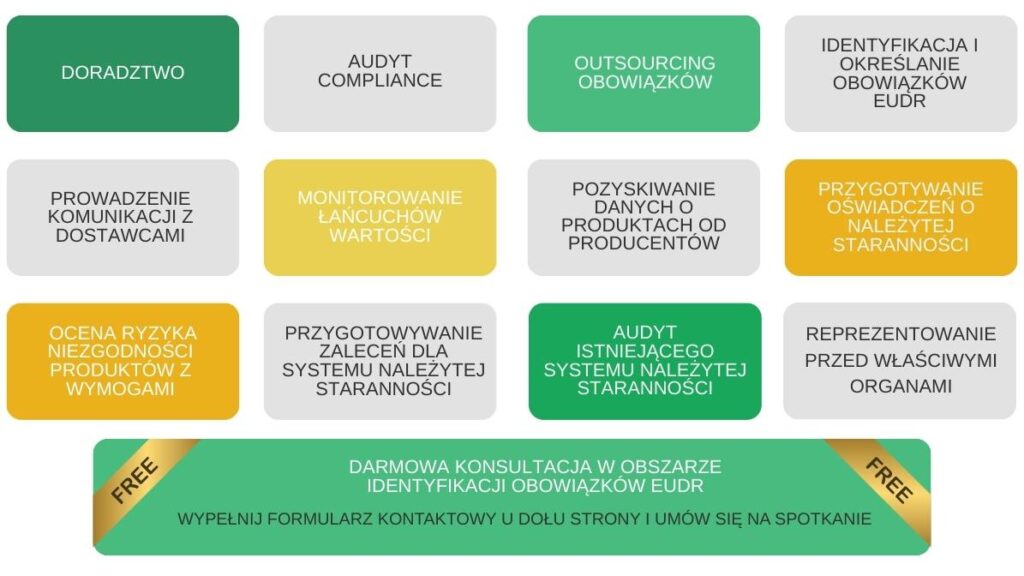
Consulting
Compliance audit in the area of EUDR
Outsourcing of responsibilities
Determining the scope of responsibilities for your company
Supply chain monitoring
Obtaining the required EUDR product data from manufacturers
Preparation of due diligence statements (DDS) and their disclosure in the EUDR IT system
Assessment of the risk of non-compliance of your products with requirements
Preparing recommendations for your company's due diligence system
Conducting a due diligence system audit at least once a year in accordance with the requirements of the EUDR Regulation
Supporting your company in its dealings with the relevant authority
xx
III. EUDR CALENDAR
The obligations for large and medium-sized enterprises will begin on December 30, 2025, and for small and micro enterprises on June 30, 2026.
The graphic below illustrates the original assumptions and current dates in the EUDR calendar.
xx
IV. EUDR PROCEDURE
The EUDR Regulation specifies the actions that a company must take in order to legally trade EUDR products. The end result of these actions is the submission of a due diligence statement for each product. This statement is necessary if the company wants to sell its products.
Below you will find the steps you need to take as a company subject to EUDR obligations. If you have any issues with any stage of the EUDR procedure, please contact us. We support companies at every stage of their journey towards EUDR compliance.
xx
STAGES OF THE EUDR PROCEDURE
xx
DATA ACQUISITION AND COLLECTION
xx
First, the company is required to collect data on the EUDR products it intends to sell. At this stage, the entire supply chain must be traced, i.e., it is necessary to find out which entities were involved in trading the products before they reached the company and collect the required information from those entities. The end result of this stage is to have all the required information about the products, including:
description, trade name, list of goods from which the final products were manufactured
geographical coordinates of the plots of land where the goods used to make the final products were produced
name, postal address, and email address of each company in the supply chain
xx
ASSESSMENT OF COLLECTED DATA IN TERMS OF RISK OF NON-COMPLIANCE WITH REQUIREMENTS
xx
At this stage, the company is required to evaluate the collected data to determine whether there is a risk that the products do not comply with the EUDR. The risk assessment takes into account, among other things, the following criteria:
the prevalence of deforestation or forest degradation in producing countries
complexity of supply chains
the risk of mixing the company's products with products of unknown origin or produced in areas where deforestation or forest degradation occurs
If, after risk assessment, it turns out that the existing risk of non-compliance with the EUDR is greater than negligible, then the company must refrain from making its EUDR products available within the European Union and from exporting them from the Union.
xx
IMPLEMENTATION OF APPROPRIATE RISK MITIGATION MEASURES
xx
The implementation of appropriate and proportionate risk mitigation measures is necessary if the risk assessment identifies a risk of non-compliance that is greater than negligible. The company must ensure that the risk becomes negligible or zero by implementing measures such as:
requiring suppliers or manufacturers to provide additional information, data, or documents
conducting independent research and audits
implementation of model risk management practices
xx
PREPARATION AND PUBLICATION OF DUE DILIGENCE STATEMENTS FOR EACH PRODUCT IN THE EUDR OPERATING SYSTEM
xx
If a company has exercised due diligence with regard to a given product, i.e., it has undergone the procedures described in steps 1-3, it should submit a due diligence statement for that product. Such a statement should be submitted in the IT system created for the purposes of the EUDR and should contain specific data, including:
country of production and geolocation of all plots where the product was produced
CN code, description, name, quantity of product purchased or sold
xx
PREPARATION AND IMPLEMENTATION OF THE DUE DILIGENCE SYSTEM
xx
The due diligence system includes the preparation and implementation of all procedures, instructions, actions, and documentation that lead to product compliance with EUDR requirements.
The company is also required to report and continuously monitor changes affecting the compliance of EUDR products with the requirements of the EUDR Regulation.
ECHO HAS BEEN SUPPORTING COMPANIES AT EVERY STAGE OF THEIR OBLIGATIONS SINCE THE INTRODUCTION OF CBAM. WE HAVE BEEN WITH YOU FOR 2 YEARS NOW. DURING THIS TIME, WE HAVE SUBMITTED SEVERAL HUNDRED REPORTS, COMMUNICATED WITH THOUSANDS OF SUPPLIERS, AND PERFORMED TWO ON-SITE AUDITS AT FACILITIES IN ASIA.
xx
WHAT DO WE DO?
AS ONE OF THE FEW COMPANIES IN POLAND, WE HAVE CBAM EXPERTS WHO HAVE BEEN WORKING IN ENVIRONMENTAL PROTECTION FOR YEARS. THANKS TO THIS, NOT ONLY WILL WE FULFILL YOUR CBAM OBLIGATIONS FOR YOU, BUT ALSO CONDUCT AN AUDIT OF YOUR PRODUCTION FACILITY, CHECK EMISSION DATA, AND IDENTIFY OPPORTUNITIES FOR OPTIMIZING EMISSION INDICATORS.
xx
WHY IS IT WORTH WORKING WITH US?
We offer comprehensive support – combining expert legal knowledge with environmental experience. We have been performing energy and compliance audits in companies for years. As one of the few players on the CBAM market, we know how to calculate emissions, optimize emission indicators, and verify data provided by suppliers. Our goal is to build a competitive advantage for your company through responsible emissions management.
Our competitive advantage is that we advise suppliers on how to calculate emissions associated with the production of goods. We propose solutions that support emission reduction in the supply chain, which is important in the context of CBAM-related costs.
We ensure that all calculations comply with the required methodologies and that the reporting process runs smoothly and without risk of errors. We estimate CBAM costs and identify the most optimal partners. This gives your organization the confidence that it not only meets regulatory requirements, but also makes the best business decisions.
WHAT YOU GAIN BY WORKING WITH ECHO??
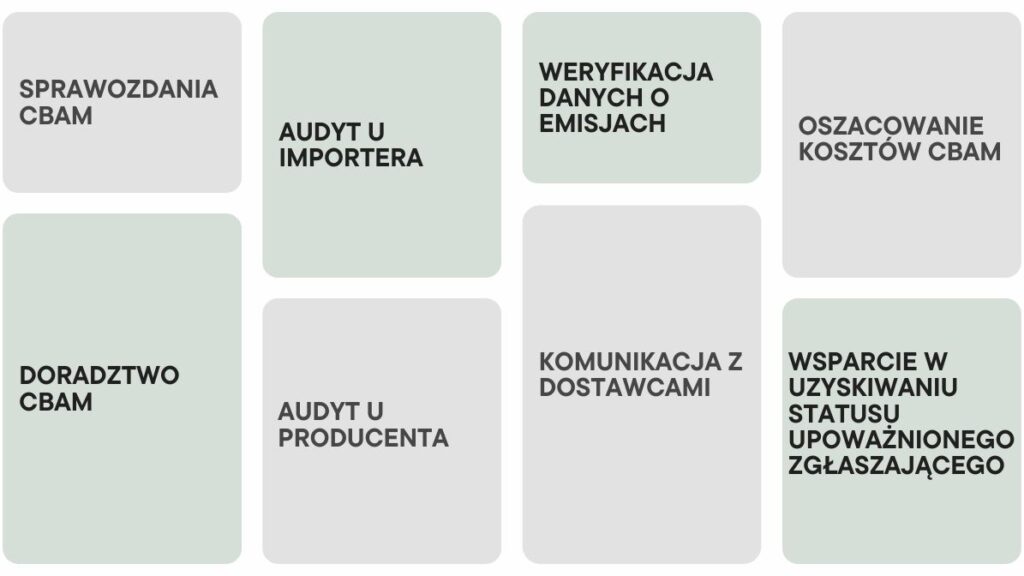
Wsparcie w uzyskaniu statusu upoważnionego zgłaszającego CBAM oraz w obsłudze rejestru docelowego CBAM.
Przygotowanie i składanie rocznych deklaracji CBAM.
Audyt CBAM w Twojej firmie obejmujący analizę importu, kodów CN, dostawców, dokumentacji celnej oraz danych o emisjach.
Fachowe doradztwo na każdym etapie realizacji obowiązków CBAM.
Przejęcie komunikacji z dostawcami oraz producentami towarów CBAM.
Weryfikację danych o emisjach otrzymanych od producentów towarów CBAM pod kątem ich kompletności, spójności i poprawności.
Doradztwo dla operatorów instalacji poza UE w zakresie prawidłowego monitorowania i raportowania emisji.
Szacowanie obowiązków finansowych związanych z CBAM, w tym liczby wymaganych certyfikatów CBAM i potencjalnych kosztów emisji.
Wsparcie w kontaktach z właściwymi organami i instytucjami odpowiedzialnymi za CBAM, w tym PUESC, KAS, KOBiZE oraz Dyrektorem Izby Administracji Skarbowej w Poznaniu.
xx
DOES CBAM APPLY TO YOU?
Jeżeli importujesz towary z sektorów objętych mechanizmem CBAM, zgłoś się do nas. Bezpłatnie zweryfikujemy, czy Twoja firma podlega obowiązkom wynikającym z przepisów CBAM oraz w jakim zakresie należy je realizować.
Analizę rozpoczynamy od weryfikacji Twojej sytuacji importowej. Sprawdzamy w szczególności kody CN importowanych towarów, kraje pochodzenia, dostawców, wolumen importu oraz dokumentację celną. Na tej podstawie ustalamy, czy importowane produkty są objęte CBAM, czy zastosowanie może mieć próg 50 ton netto rocznie oraz jakie obowiązki mogą dotyczyć Twojej firmy.
Jeżeli zdecydujesz się na współpracę z ECHO, przejmiemy obsługę procesu CBAM w uzgodnionym zakresie. Możemy wesprzeć Cię m.in. w uzyskaniu statusu upoważnionego zgłaszającego CBAM, obsłudze rejestru docelowego CBAM, kontakcie z dostawcami i producentami, pozyskiwaniu danych o emisjach, weryfikacji ich poprawności oraz przygotowaniu rocznej deklaracji CBAM.
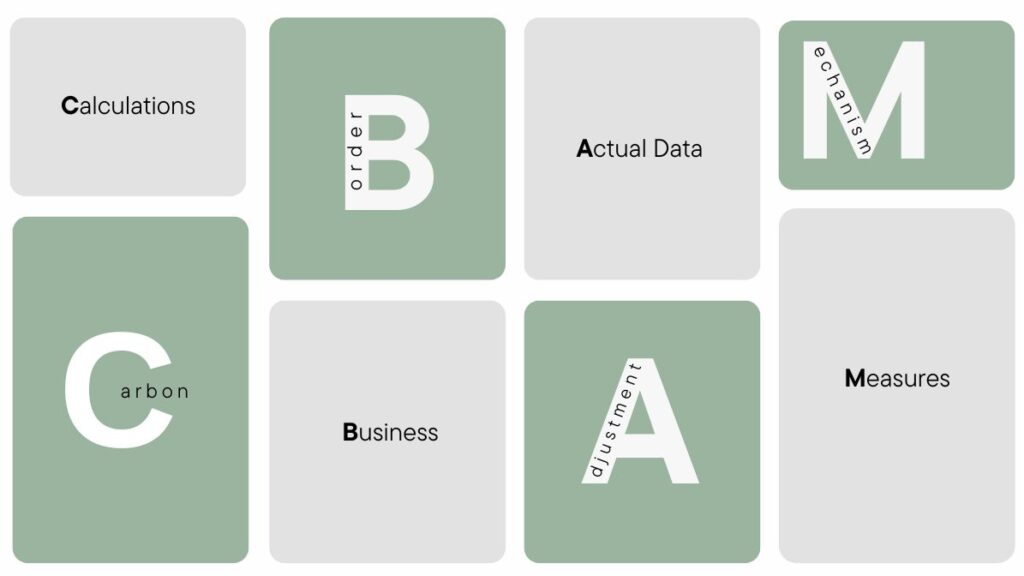
W praktyce CBAM oznacza konieczność regularnych działań w czterech kluczowych obszarach:
Calculations – monitorowanie skali importu CBAM, analiza danych oraz obliczanie potencjalnych obowiązków i kosztów związanych z CBAM;
Business – dostosowanie relacji z dostawcami i producentami do wymagań CBAM, tak aby łańcuch dostaw był bezpieczny, przewidywalny i przygotowany na nowe obowiązki;
Actual Data – pozyskiwanie rzeczywistych danych CBAM od producentów towarów, pochodzących z instalacji, w których towary zostały wytworzone;
Measures – measurements are mainly on the part of your suppliers – monitoring production processes and counting emissions; however, it is worth verifying these measurements and asking for their optimization if they are not cost-effective for you.
xx
If you do not want to fulfill your CBAM obligations yourself, we encourage you to use our services.
COST-FREE CBAM CONSULTATION – DETERMINE YOUR OBLIGATIONS
Knock Knock Echo Solutions app means high standards, more time savings, and reduced risk of non-compliance with legal requirements. Install the app and see how much you gain every day.
– Knock Knock Echo Solutions app – We're launching another Records Cloud Module!
Obligations arising from both national and European legislation on the use of the environment include, among other things, the need to submit reports to state authorities and pay various types of fees. In order to fulfill the above obligations, entrepreneurs are first and foremost required to keep proper records of, among other things:
placed on the market:
:
SUP packaging,
packaging,
batteries and accumulators,
tires, oils, and lubricants,
electrical and electronic equipment,
fishing gear (from 2024),
packaging covered by the deposit system (from 2025).
acquired and issued:
packaging covered by the deposit system (from 2025),
plastic bags,
exported and manufactured:
packaging.
In the Records Cloud module, you will find: ready-made forms for keeping records in accordance with the law, information on all the obligations you must fulfill, and support from experienced experts.
KEY ADVANTAGES OF THE RECORDS CLOUD MODULE:
full compliance with legal requirements and reduction of administrative fines,
cost-free e-audit,
current statements, balances on your phone, computer,
the records summary data downloaded from the application are ready-made documents that you can use to prepare statements, reports, and calculate environmental fees.
the data in the application will be a ready-made document that you can show during an inspection.
notifications about changes in the law regarding your records,
assistance from experienced experts,
transparent form,
simple and remote navigation,
optimization of activities,
saving time - you can take care of your business better,
can be operated on various devices.
–
Support for your activities at BDO – Waste Cloud module
The only application available on the market in which you will produce and transfer waste in accordance with the law. An additional advantage is the transparency and easy possibility of transferring waste.
WASTE GENERATION in the waste generation tab, you can generate waste and you will be able to verify whether the given precipitation name is on your list.
WASTE TRANSFER in the waste transfer tab you can quickly and easily transfer waste to your waste recipient. Remember that you can always report several wastes at once!
REPORT STATUSES In this tab, you can easily and clearly view all the waste transfer reports you have completed.
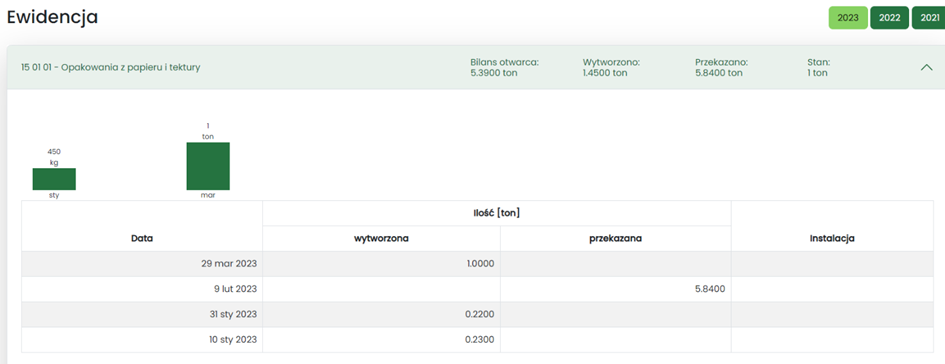
RECORD You have access to your data stored in BDO at any time, i.e., the weight of waste you have generated and the weight of waste transferred to the recipient. During an inspection, you can present your current data using this tab.
The records are being developed, thanks to which you have access to a visual presentation of the waste generated in your company throughout the year.
KEY ADVANTAGES OF THE WASTE CLOUD MODULE:
automation in the process of agreeing waste collection dates – all it takes is two CLICKS,
current statements, balances, and application statuses available 24 hours a day on your phone or computer,
alerts monitoring the validity of waste collection decisions,
alerts about the end of waste storage time,
alerts about the need to obtain a permit to generate waste,
the possibility of determining the correct waste code with an expert – just send a photo of the waste, provide the codes you are unsure about, and our expert will contact you,
full compliance with legal requirements and reduction of administrative fines (which can be up to PLN 1,000,000whenever you are working with the application,
waste records kept exemplary in BDO,
the risk of errors is minimized, e.g., it will not be possible to deliver waste to a company that does not have a valid decision.
transparent form,
simple navigation,
optimization of activities,
saving time - you can take care of your business better,
remote navigation (from home, sea and every trip),
can be operated on various devices.
Remember, the obligations imposed on entrepreneurs are necessary to prevent and counteract the harmful effects of human activity on the environment, and failure to comply with them has serious consequences for the entrepreneur.
If you value modern tools that will help you meet environmental requirements, please contact us. We will be happy to tell you more about the Knock Knock Echo Solutions application.
Please contact us using the form below or call +48 577 052 973.
The assessment of compliance with the legal requirements of occupational health and safety covers the entirety of the provisions in the field of legal requirements relating to the enterprise. Our assessment may also serve as the fulfillment of the obligation described in point 9.1.2 of the standard: ISO 45001: 2018.
It is a good practice to combine the assessment of compliance with legal health and safety requirements with the requirements of environmental protection.
As part of the conformity assessment we carry out verification of documentation, inspection of work stations, and tours around the plant. The assessment report is also based on oral information obtained from plant employees, in particular those dealing with health and safety management issues.
The scope of the assessment covers, among others, areas of health and safety law, such as:
General health and safety requirements;
Advisory and control bodies in the company - OHS service and OHS commission;
Work regulations and protection of the work of women and young people
Accidents at work and occupational diseases;
Research and measurement of the working environment;
Electromagnetic fields in the work environment;
Carcinogenic and mutagenic factors in the work environment;
Biological factors in the work environment;
Occupational risk assessment;
Preventive health protection of employees;
Training in the field of occupational health and safety;
Works with special legal conditions;
Putting into use of construction works and their operation;
Machine safety requirements;
Technical inspection of devices;
Safety of work with energy devices and installations;
We carry out health and safety audits of buildings, processes and working conditions in enterprises. A health and safety audit may be the implementation of the employer's obligation under the Labor Code to control the health and safety condition. The employer is obliged to ensure systematic inspections of the health and safety at work, with particular emphasis on the organization of work processes, the technical condition of machines and other technical devices, and determine the methods of registering irregularities and methods of their removal.
Our audits also fulfill the obligation described in point 9.2 of the standard: ISO 45001: 2018 or may result from high standards of operation imposed by business partners and customers, the parent company.
The scope of the OHS audit is planned in the following areas, among others:
conduct of employees: use of personal protective equipment by employees, use of occupational health and safety instructions when operating machinery and equipment, performing particularly hazardous and fire hazardous works;
working conditions: work rooms, workstations, hygienic and sanitary rooms;
safety during the operation of machines and devices: inspection of machines and devices, protection of machines in motion (shielding systems, safety barriers, etc.)
workplace, infrastructure and facilities;
warehouses: storage of materials and products (including hazardous materials);
operation of means of transport,
and other areas relevant to the client
Each health and safety audit produces a detailed report confirming the correct operation of the plant, in which we also discuss areas with non-conformities. In the report, at the client's request, we describe recommendations and further steps to ensure full compliance with legal requirements.
The purpose of the training is to fulfill the employer's obligation resulting from, inter alia, Art. 237 (3) of the Labor Code and the Regulation of the Ministry of Economy, Labour and and Social Policy of 27 July 2004 (as amended) on training in the field of occupational health and safety.
Occupational health and safety training includes, among others, updating, supplementing knowledge and skills, in particular in the field of:
assessment of hazards occurring in work processes and related to the performed work,
risk assessment related to these threats,
methods of protection against threats to the health and safety of employees,
shaping working conditions in a manner consistent with the provisions and principles of occupational health and safety,
proceedings in the event of an accident and in emergency situations,
during the training, we also present system solutions that have an impact on increasing and improving work safety, such as: the "LOCKOUT / TAGOUT" system, tools from the "KAIZEN", "5S" philosophy, etc.
Periodic health and safety training includes workplaces:
managerial - persons managing employees, in particular managers, directors,
engineering and technical,
administration and office - people employed in administrative and office positions,
workers - persons employed in executive positions (including particularly dangerous work positions).
Based on many years of experience, we have created a complete offer tailored to the type and scope of services to the expectations of customers.
In our company, we approach each client in a very individual way.
Cooperation procedure:
Matching the appropriate training in the field corresponding to the individual requirements of your company and training group;
Organizing selected training from scratch, according to the specific needs of your company and its preferences (we offer remote and stationary training, located at the client's or in our training rooms);
Assessment of newly acquired skills by employees after the completion of the training process and feedback to the employer.
Thanks to many years of experience in the industry and ongoing services for companies, we have the necessary substantive and practical experience to comprehensively carry out the assessment process in your company.
Thanks to our offer, the complexity and multitude of legal acts will no longer be a problem for your company. We will identify new requirements and take care of the correct interpretation of regulations and updating your registers of legal requirements in environmental protection and health and safety.
Our offer include:
Environmental Outsourcing, Health & Safety
Support and consultancy in the field of environmental protection and health and safety. Consultations may be conducted remotely or combined with the secondment of an ECHO specialist to the plant's premises.
In what topics can we support you:
fees for using the environment in the field of: gas or dust emission into the air, waste storage in landfills,
product fees - concerning packaging and electronics, batteries and accumulators placed on the market, as well as tires, lubricating oils and lubricating preparations,
recycling fees
reporting on products, packaging and waste management,
greenhouse gas emissions and other emissions (KOBiZE)
emission records, VOC balance,
PRTR reports,
waste generation and waste management methods - registration in the BDO database, registration and reporting,
support for the SENT database,
maintenance of the Central Register of Operators (CRO) regarding F-gases,
operating the Database on ODS and FGC (BDS), i.e. on substances that deplete the ozone layer (ODS) and fluorinated greenhouse gases and other fluorinated greenhouse gases,
entry and comprehensive service of the Waste Database (BDO) - for all entities introducing products, packaged products and waste management, shops and wholesalers, which are subject to a recycling fee for plastic bags
cyclical internal ISO audits,
cyclical assessment of compliance with the requirements of environmental protection law, occupational health and safety,
supervision over environmental and health and safety documentation
supporting the organization in maintaining and improving ISO management systems
other areas important for clients that the company does not deal with on a daily basis.
Cooperation procedure:
Analysis of the scope of using the environment - zero audit
Preparation of necessary reports, documents, reports, calculation of fees, etc.
Submission of documentation to appropriate offices
Thanks to many years of experience in the industry and ongoing service for companies, we have the necessary substantive and practical experience to comprehensively carry out the process of assessing your company.
2. Environmental documentation
Preparation and correction of all documents related to the functioning of the organization in the field of environmental protection and occupational health and safety, including, inter alia: preparation of applications, reports, reports, water law surveys, environmental impact reports, KIPs (Project Information Sheet), reports on internal audits, discharging wastewater, air emissions (both substances and noise) as well as chemicals and waste management - including the operation of the BDO base.
The most common mistakes when keeping waste records:
failure to keep a waste register card (simplified waste register),
records of selected waste only,
giving weight in registration documents in kg,
incorrect records of waste generated outside the installation,
one waste register common for several places of business.
When it concerns:
If you want to check whether you are correctly fulfilling your obligations in the field of environmental protection;
If you are not sure if you comply with all the provisions of Polish law that apply to you
Polish law has changed and you do not know the consequences for your company
You're expecting an organ check.
3. Management systems – ISO 14001, ISO 9001, ISO 50001, ISO 45001 etc.
Supervision over the implementation and operation of the Environmental Management System (ISO 14001, EMAS), the Quality Management System (ISO 9001), the Energy Management System (ISO 50001), the Occupational Health and Safety Management System (ISO 45001), integrated systems and others. We provide consultations and support in environmental and energy audits and reviews, system integration or assuming all responsibilities for maintaining the ISO management system in the organization.
Our team of experts will be happy to support your company during the control of external bodies, third party audits. We also provide inspection of your company and indication of irregularities as well as the procedure to be followed before the announced inspection.
The main areas inspected by the Polish Inspection of Environmental Protection are:
large, medium and small plants where there is a possibility of an industrial failure,
chain of large-format stores and others,
operation of large-scale pig farms,
operation of a vehicle dismantling station
production, collection and processing of waste batteries and accumulators
compliance with the provisions of the act on waste electrical and electronic equipment
functioning of the sewage treatment plant
activities of waste treatment plants and landfills
municipal waste management in communes
utilization of infectious medical and veterinary waste
industrial noise
international shipments of waste
emission of pollutants into the air
management of water resources
and many other areas
When it concerns:
The announced inspection by the Polish Voivodeship Inspectorate of Environmental Protection
Announced inspections of offices issuing environmental decisions
If you want to check whether you are correctly fulfilling your obligations in the field of environmental protection;
If you are not sure if you comply with all the provisions of Polish law that apply to you
You want to properly implement the follow-up activities
Certification audits of Management Systems
Third party audits to verify that you are complying with the law and procedures.
Penalties and sactions:
1. Packaging waste management
Failure to keep records of packaging in which products are placed on the market in a given calendar year may result in a fine of PLN 10,000 to 500,000.
For failing to provide the contracted packaging recovery organization with all necessary data enabling the fulfillment of the obligations taken over by it, from PLN 10,000 to 500,000.
Penalty for the lack of or errors in the implementation of the obligation to recycle and recover packaging waste - the so-called the product fee depends on the weight and type of packaging.
Failure to allocate 2% of the net value of all packaging placed on the market in the past calendar year for educational campaigns or for the account of the Marshal's Office is a fine from PLN 10,000 to PLN 500,000.
A fine for failure to notify about the commencement of activities related to the production, import or purchase of packaged products.
Lack of appropriate entries in the BDO database is a penalty from PLN 10,000 to PLN 1,000,000
A penalty from 5,000 to 1,000,000 for not placing the registration number on the documents drawn up in connection with the business activity covered by the entry in the Register-BDO
Penalty for failure to submit an annual report on products in packaging, packaging and packaging waste management.
2. Waste management
A fine for incorrect and not timely keeping of waste records, in accordance with the actual state.
Handover of waste to unauthorized entities without appropriate decisions or entry in the register is punishable by detention or a fine
Collecting and processing waste without the required permit is a fine of not less than PLN 1,000 and not more than PLN 1,000,000, while non-compliance with the permit is a fine - PLN 10,000 for transport, from PLN 1,000 to 1,000,000 for collecting or processing.
Do not mix different types of hazardous waste and do not mix hazardous waste with non-hazardous waste. Penalty for breaking the rules: from PLN 1,000 to 1,000,000.
Administrative fines are imposed for:
reclassification of hazardous waste into non-hazardous waste by diluting or mixing it with each other or with other waste, substances or materials, leading to a reduction of the initial concentration of hazardous substances to a level lower than the level specified for hazardous waste,
mixing hazardous waste of different types, mixing hazardous waste with non-hazardous waste, or mixing hazardous waste with substances, materials or objects,
transport of waste contrary to the requirements referred to in Art. 24 of the Waste Act,
waste storage contrary to the requirements referred to in Art. 25 sec. 1-6 of the Act on waste and the Regulation of the Minister of Climate of September 11, 2020 on detailed requirements for the storage of waste
failure to implement a visual inspection system for the place of storage or storage of waste or to run this system contrary to the provisions of Art. 25 sec. 6a of the Waste Act,
failure to put the registration number on documents drawn up in connection with the conducted activity,
discharge of waste oils to water, soil or soil.
3. Air emissions
Operating the installation without a permit or notification may result in arrest or a fine
Failure to submit fees for the economic use of the environment is punishable by a fine
Failure to submit fees for Polish National Centre for Emissions (KOBiZE) is punishable by a fine. Failure to report information on the operation of the installation, failure to meet these obligations or operation of the installation inconsistently with the submitted information is subject to a fine
4. Water and sewage management
Operation of the installation without a water permit, notification or violation of the content of this permit means a fine, arrest or restriction of liberty.
5. Integrated permits
Operation of the installation without a water permit, notification or violation of the content of this permit means a fine, arrest or restriction of liberty.
6. Submission of the PRTR report
The entrepreneur who runs the installation is required to submit a PRTR report. If he fails to do so, the voivodship environmental protection inspector may impose a fine on him in the amount of PLN 50,000. Providing untrue, incomplete, inconsistent or unreliable data in the report may be punished with a fine of PLN 25,000.
7. CRO - Central Registry of Operators
Operators of equipment (refrigeration, air conditioning, heat pumps) and fire protection systems that contain at least 2.5 kg of controlled substances or 5 tonnes of CO2 equivalent of fluorinated greenhouse gases are required to register with the Central Registry of Operators (CRO). Operators are obliged to keep records on activities related to the control and maintenance of devices on an ongoing basis. Failure to meet the deadline for entries in the CRO database results in an administrative penalty for the operator from PLN 600 to PLN 4,500.
Concern for the environment currently requires the management of the enterprise on the principles of sustainable development. Each company should plan its activities, being aware of the impact that they can have on the environment.
To achieve this, our company offers a wide range of training courses for all organizations that want to have qualified staff in their company.
We provide training in the following areas:
Waste management
BDO (Polish Waste Database), CRO (Central Registry of Operators) support
Environmental protection requirements for the production plant, office, administration
Implementation of individual ISO systems - ie 14001, 9001, 50001, 45001, EMAS and others
Training for internal auditors of integrated ISO systems
Training for the top management within the implemented or implemented ISO systems
Others dedicated to each client
We know that individual industries have their own needs, business goals or job specifics, so everyone can expect something different, even from the same training. In order to meet the expectations of our clients, we adjust our training plans and scopes to fully meet them, and the training was an ideal response to the participants' requirements.
Based on many years of experience, we have created a complete offer tailored to the type and scope of services to the expectations of customers.
In our company, we approach each client in a very individual way.
Cooperation procedure:
Matching the appropriate training in the field corresponding to the individual requirements of your company and training group;
Organizing selected trainings from scratch, according to the specific needs of your company and its preferences (we offer remote and stationary training, located at the customer's or in our training rooms);
Assessment of newly acquired skills by employees after the completion of the training process and feedback to the employer.
Why is it worth implementing an ISO management system in an organization?
A professionally implemented system in a company can bring many benefits, the most important are:
obtaining the international ISO certificate recognized all over the world, which translates into easier access to markets where high environmental and energy standards are required,
improving relationships with customers, business partners and local authorities by ensuring the transparency of the organization's activities,
reduction of costs in the field of waste management, water management, consumption of raw materials and energy,
improving the image and communication within and outside the organization,
organizing work in the company in terms of responsibility, policy implementation and achieving goals,
reducing the risk of penalties for non-compliance with the law applicable to a given organization,
reducing the risk of penalties for non-compliance with the law applicable to a given organization,
It is important to remember that every company, regardless of the level of development and technologies used today, can successfully implement a management system and then certify it. The question that should always be asked is this - what is the purpose of implementing the system and is the top management determined to maintain the system in their organization?
Our experienced team of experts and auditors will assist any organization in implementing various management systems. The most popular systems in which we provide comprehensive consulting services are:
Environmental Management Systems ISO 14001 or EMAS
ISO 50001 Energy Management System
ISO 9001 Quality Management System
ISO 45001 Occupational Health and Safety Management System
ISO 27001 Information Security Management System
Integrated Management Systems
Virtually every system implementation process can be divided into several stages:
Stage I
Conducting a zero audit and identifying gaps and work schedule
Stage II
Conducting trainings for the managerial staff, implementation team, internal auditors, technical team
Stage III
Conducting audits of compliance with legal requirements, energy inspections or environmental inspections
Stage IV
System analysis - defining the scope and boundaries of the system, policies, processes, context, risks and opportunities as well as other system elements required by standards
Stage V
Development of documentation and documented information
Stage VI
Consultations with the implementation of the system by the client
Stage VII
Internal audits
Stage VIII
Preparing for certification
When it concerns:
If you want your company to have developed policies, procedures, methods and management tools;
If you want to show your contractors that your company focuses on the quality system, cares about the environment, applies the highest energy and health and safety standards and takes care of the highest safety standards;
If you need to standardize key processes in your organization.